Cover Letters Aren't Dead. Here's What Hiring Managers Told Us.
If you have ever skipped writing a cover letter because you heard “nobody reads them anyway,” you were working off old, bad information. That 55% stat you have seen floating around job search articles for years? Outdated. The real numbers tell a very different story, and they matter for anyone doing a job search, career change, or resume update right now.
83% of Hiring Managers Read Cover Letters
What hiring managers really say
In a Resume Genius survey of 625 hiring managers, 83% said they always or frequently read cover letters. Only 4% said they rarely or never look at them. Even more telling, 45% of hiring managers read the cover letter before the resume. And here is the part that surprises most job seekers: among companies that do not require a cover letter, 73% of hiring managers still read one frequently or always when it is included.
So the “nobody reads it” excuse just does not hold up anymore.
How much time do you actually have?
Here is where a lot of well-meaning advice goes wrong. People assume that because hiring managers move fast, cover letters do not matter. In reality, speed is exactly why they do. About 36% of hiring managers spend less than 30 seconds on a cover letter, 48% spend between 30 seconds and two minutes, and 15% spend more than two minutes. That is a tight window, but it is a window. A crisp, targeted letter that gets to the point in the first few lines can do a lot of work in 30 seconds. A generic one wastes it.
Does a cover letter actually change the outcome?
Yes, and the numbers back it up. Ninety-four percent of hiring managers say a cover letter impacts their decision, and 49% say a strong letter has landed interviews for candidates who might otherwise have been passed over. Including a cover letter increases your odds of landing an interview by 50%, and a well-written one with specific examples can push that number up to 75%. Land your dream job with a killer cover letter.
Company size and industry change the equation
Cover letters carry more weight at some companies than others. Medium and large organizations, meaning 100 or more employees, are more than twice as likely as small companies to call a cover letter “very important,” 34% versus 15%. The reason shifts, too. Small companies read a cover letter to see if you fit the culture. Medium-sized companies read it to get a feel for your personality. Large companies read it to understand why you are applying in the first place.
Industry matters just as much. Cover letters are still considered essential in government, banking and finance, luxury, management consulting, education, healthcare, and nonprofit work. In communication-heavy fields like marketing, journalism, and nonprofit leadership, where writing ability is part of the job, 70% of hiring managers still view a cover letter as essential. Tech, startups, and creative fields tend to be more relaxed. A short, direct note or a strong LinkedIn profile can sometimes carry the same weight.
When skipping it can quietly end your candidacy
A few situations should make you stop and think twice before hitting submit without one.
If the job posting requests or requires a cover letter, sending one shows you can follow instructions. Skipping it sends the opposite message. Even when a cover letter is listed as optional, 72% of companies still expect one and treat it as a test of motivation and effort. With hundreds of applicants for most open roles, some companies will screen out a resume with no letter attached before a human even reads it.
If you are changing careers, coming back after a gap, or just graduating, a cover letter matters even more. It is your chance to explain the context that a resume cannot cover on its own.
I saw this firsthand years ago when I was the HR Director for a food service and catering company. A resume came across my desk from an attorney who wanted to make a career change into event planning. There was no cover letter attached, so I had no context for why an attorney was applying for this role or how their background connected to the job. Without that explanation, the resume went straight into the “no” pile. A short cover letter could have easily changed that outcome.
The generic letter problem
Here is the flip side of all this good news for cover letters. A bad one can actively hurt you. Eighty percent of hiring managers have rejected a candidate specifically because of a generic or poorly written cover letter, and 90% of rejected cover letters were turned down for lack of customization. In other words, a copy-and-paste letter is often worse than no letter at all. The message is simple. Tailor it, or skip it.
Two ways to make yours stand out
Over the years of writing cover letters with clients, two approaches have consistently worked best. Read: How to instantly improve your cover letter.
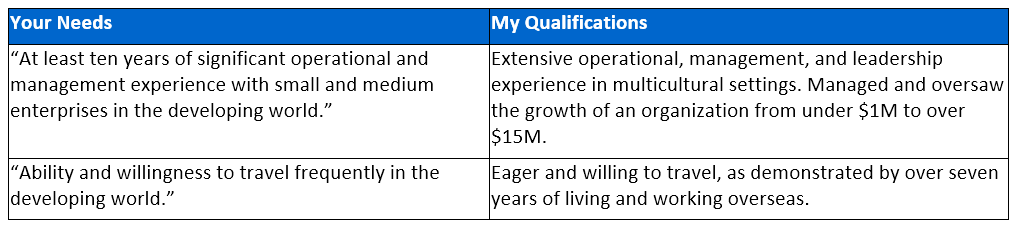
The first is a direct match strategy. Pull the actual language from the job posting and line it up next to your qualifications, almost like a checklist. One client used this format to land a Chief Operating Officer role, mapping each requirement in the posting directly to a specific accomplishment. It works because it connects the dots and does the hiring manager's job for them. They do not have to guess whether you fit. You have already shown them.
Excerpt from a client letter using this format:
The second is an achievement-led format. Open with a short paragraph that establishes your fit, then use three focused bullet points that lead with numbers and results. This style works especially well when you are applying broadly and want a reader to be able to scan your value in seconds, which matters given how little time hiring managers actually spend on each letter.
Excerpt from a client letter using this format:
My solid record of developing and facilitating technical training, as well as providing ongoing support, makes me well qualified for your position as Regional Technology Trainer. Some of my accomplishments include:
• Increased organizational capacity to handle 300% annual growth by identifying skill gaps and developing programs to close them.
• Selected from hundreds of instructors for a two-year national project serving 36,000 users.
Both formats share the same DNA. They are specific, they are short, and they are built around the employer's needs, not a recycled summary of your resume.
A word on format
Most cover letters today travel by email or get uploaded to an online application, not printed and mailed. That shift means the old formal letter format is fading in favor of something shorter and more direct, sometimes called an e-note. A strong subject line that states the position and a headline qualification, two to three tight paragraphs or a handful of bullet points, and a clean signature block with your contact information and LinkedIn link will serve you better than a dense, formal page. Skip the letterhead in an email version. It does not translate well and can trip up applicant tracking systems.
Here is what that looks like in practice:
Subject: Operations Leader | 12 Years Cutting Logistics Costs | Applying for Regional Operations Director
Ms. Alvarez,
Your posting for Regional Operations Director caught my attention because of its focus on turning around underperforming distribution centers, which is exactly the work I have spent the last six years doing at Anthony Freight.
• Rebuilt scheduling and staffing models that cut overtime costs by 22% across three facilities.
• Led a 40-person cross-functional team through a facility consolidation with zero missed shipments.
• Promoted twice in five years for consistently exceeding regional efficiency targets.
I would welcome the chance to talk through how I could bring that same turnaround approach to your team. I am available anytime this week.
Thank you,
Harmony Whitfield | 555-555-5555 | harnonywhitfield@gmail.com | linkedin.com/in/harmonywhitfield
Do not forget the thank-you note
Cover letters are not the only piece of communication that gets skipped, and shouldn't be. A survey of hiring managers by career coach John Hadley found that 94% said receiving a thank-you note after an interview sometimes, often, or definitely affects their hiring decision, with 23% saying it definitely does. Yet only about half of interviewers said they receive them even half of the time. If you are already taking the time to write a strong cover letter, do not let a missing thank you undo that effort. Read: How to turn a conversation into a job offer.
The bottom line
The evidence is clear. Cover letters are read, they influence decisions, and they matter more in some industries and company sizes than others, but skipping one, or worse, sending a generic one, is a real risk. Readership sits at 83% overall, and in fields like law, finance, healthcare, education, government, and nonprofit work, a well-written winning cover letter is still one of the clearest ways to separate yourself from everyone else in the pile.
If you want help building a cover letter that actually gets read, that is exactly what we do at Life Working®. Reach out, and let's make sure your next application gets a second look.
Ready to Advance Your Career?
Life Working® has the expertise to help job candidates improve negotiation and interview skills. We provide comprehensive career services, including professional and executive interview preparation, resume writing, LinkedIn profile optimization, career assessments (MBTI, Strong Interest Inventory, Highlands Ability Battery), and job search strategy coaching. We work with professionals at every stage, from recent graduates to C-suite executives, serving clients nationwide from our Chicago office and helping people just like you find work where you wake up happy to go.