How to Tell If a Job Offer Is Real: A Former HR Director Walks You Through Every Step
After our last post on job scams, "I Quit My Job for a Scam," I heard the same question again and again:
How am I supposed to know what's real anymore?
It's a good question. Job scam losses reported to the FTC jumped from $90 million in 2020 to $501 million in 2024. In a 2026 survey, 67% of job seekers said they suspected they had run into fake or misleading job postings. And AI now lets scammers fake a company website, a recruiter profile, and even a face on a video call.
Most advice about job scams is a list of red flags. Red flags help, but the problem is that scammers read the same lists, and they keep removing the obvious ones.
The Hiring Process Scammers Hope You've Never Seen
Before I made the career pivot to career coaching and resume writing and started Life Working®, I was an HR Director. I've sat on the employer's side of the hiring desk as an HR Director. I know what happens inside a company before a job offer goes out, and that process leaves a trail a scammer can't easily copy.
Once you know what real hiring looks like, a fake process starts to stand out. Here's how it works, stage by stage.
What Real Hiring Looks Like, Stage by Stage
Stage 1: The job exists before anyone contacts you
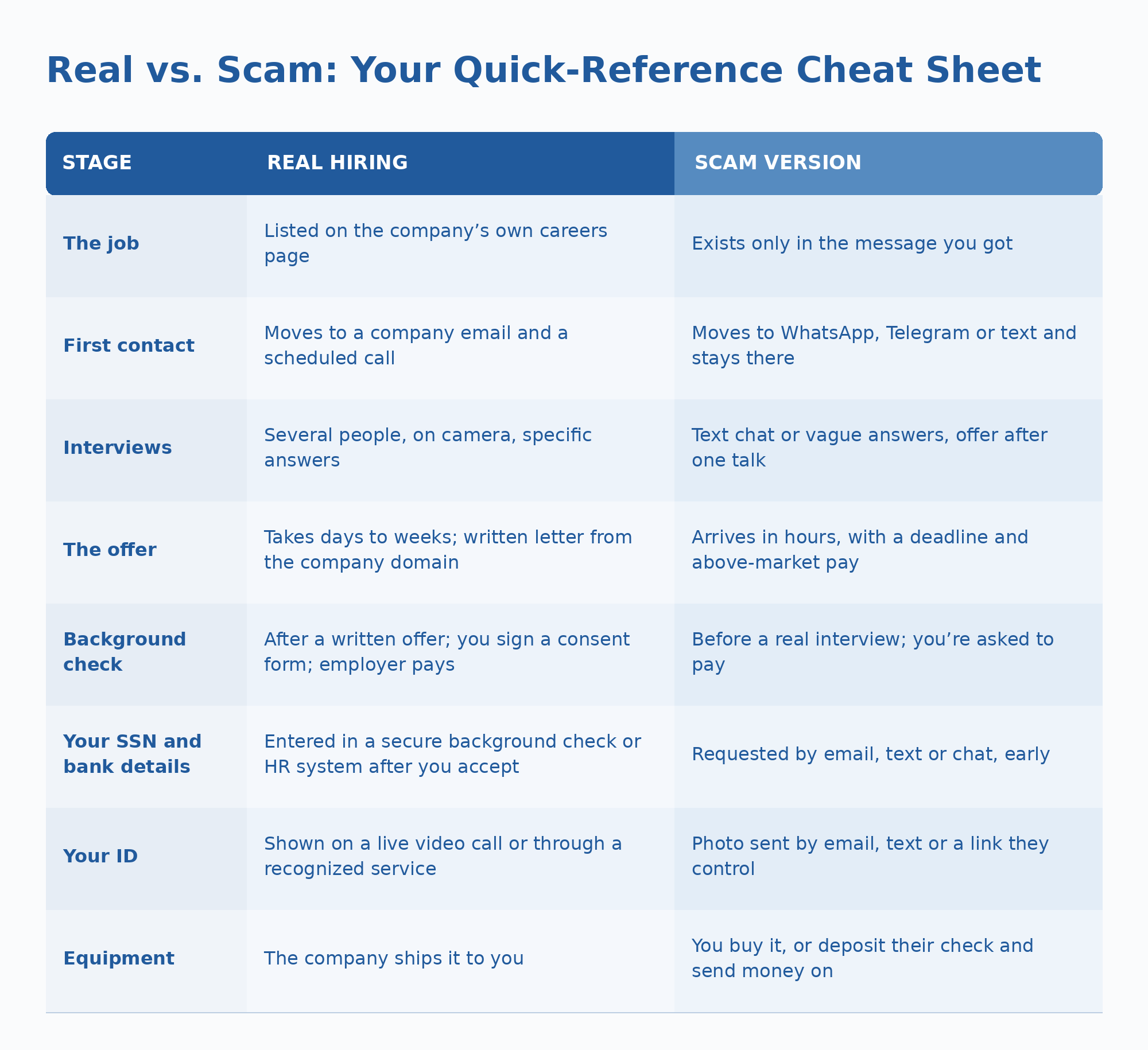
Inside a real company, a job opening starts long before you hear about it. A manager requests the position, someone approves the budget, and HR opens it in the company's applicant tracking system. That's why almost every real opening also appears on the company's own careers page.
The scam version: The "job" exists only in the message you received. You can't find it on the company's website.
Verify it: Go to the company's website yourself (don't click the link you were sent) and look for the role on the careers page. If it isn't there, call the company's main number and ask.
Stage 2: First contact comes from a real person you can look up
Real recruiters do reach out on LinkedIn. But a real conversation quickly moves to a company email address and a scheduled phone or video call. A real recruiter also wants to learn about you: your experience, your salary expectations, why you're interested.
The scam version: The conversation moves to WhatsApp, Telegram, or text and stays there. The "recruiter" asks almost nothing about your background because they don't need anything from you except your trust.
Verify it: Look up the recruiter separately, not through the profile they sent you. Check that their email domain matches the company's real website exactly.
Stage 3: Interviews involve several people, on camera, asking real questions
A real hiring process involves more than one person: usually a recruiter, the hiring manager, and often a few team members. Interviews arrive in your email inbox as calendar invitations from the company's domain and take place on Zoom, Teams, or Google Meet, with cameras on. They're a two-way conversation, and the interviewers can answer specific questions about the team and the work.
The scam version: The "interview" is a text chat, or a short call where no one can answer basic questions about the team. Or the process feels surprisingly easy, with an offer after one conversation.
Verify it: Ask specific questions. Who would I report to? What happened to the person who had this role before? What will my first 90 days look like? In my first 6 months in this position, what are the top 3 goals I can help you achieve? Real hiring managers enjoy these questions. Scammers dodge them.
Stage 4: The offer takes time, because it needs approvals
This is the inside stage that most job seekers never see. Before a real offer goes out, HR typically confirms the salary is within the approved range, gets sign-off from the hiring manager and often a senior leader, and checks references. That's why real offers usually come a few days to a few weeks after the final interview, not a few hours.
A real offer often comes first as a phone call, followed by a written offer letter sent from the company's email domain or through an e-signature or HR system. It often says it's contingent on a background check.
The scam version: An offer arrives within hours, with a deadline to accept by tomorrow. The pay is well above market for the role.
Verify it: Before you accept, call the company's main line (a number you looked up yourself) and confirm that the hiring manager exists and the role is real.
Stage 5: The background check comes after the offer, and the employer pays for it
Here is the stage where you share your Social Security number with a real employer. It happens after you have a written, conditional offer. Under the federal Fair Credit Reporting Act, the employer must give you a separate written disclosure and get your written permission before running the background check. You'll typically get an email from a background check company with a secure link to enter your information. The employer pays for it.
The scam version: You're asked for your Social Security number, a photo of your driver's license, or a fee for the background check before you've had an interview or a written offer.
Verify it: Never pay for a background check. If a background check company contacts you, confirm with the employer that they're using that company before you enter anything.
Stage 6: Onboarding paperwork happens at or right before your first day
Federal I-9 employment verification paperwork happens after you've accepted the offer, usually on or just before your first day. Tax forms and direct deposit are usually set up through the company's secure HR or payroll system, such as Workday or ADP, not by email or text.
The scam version: You're asked to send bank account details for "direct deposit setup" by email or in a chat, often before you've signed anything.
Verify it: Only enter banking information in a secure HR or payroll portal you reached through the company's official website or your new company email.
Stage 7: The company gives you equipment. You never pay for it.
When a remote job needs a laptop, the company's IT department ships one to you or arranges a pickup. You don't buy your own equipment from a vendor they name, and they never send you a check to deposit and then ask you to send part of the money elsewhere.
The scam version: You get a check to "buy equipment from our approved vendor." The check bounces days later, after you've sent money. Or you're simply asked to pay for your own computer, which is the request that finally tipped off the job seeker in our last post, after she had already resigned from her job.
Verify it: Never pay to get a job. If an employer sends you money and asks you to send some of it on, stop.
The New Twist: When the Employer Asks You to Prove Who You Are
Here's something that confuses a lot of job seekers right now. Employers are worried about scams too, from the other direction.
Companies are now seeing fake candidates: people using stolen identities, AI-written resumes, and even deepfake videos to get hired into remote jobs. Gartner predicts that by 2028, one in four candidate profiles worldwide could be fake. In the same Gartner research, 6% of job candidates admitted to interview fraud, either impersonating someone else or having someone else pose as them.
So legitimate employers have started adding identity checks to hiring. You may be asked to keep your camera on, hold your ID up to the camera, come in for an in-person final interview, or verify your identity through a third-party service. That's new, and it can feel exactly like the scams you've been warned about.
It doesn't help that trust is already low. Gartner found that only half of job candidates believe the jobs they're applying for are even legitimate.
Here's how to tell the difference.
A legitimate identity check usually:
Happens after you've already spoken with real people at the company, live and on camera
Asks you to show your ID on a live video call, not send a photo of it by email or text
Uses a recognized identity verification service, sent from the company's own email domain or its hiring system
Is explained to you, including why they need it and who will see your information
Happens during onboarding for your I-9. Some employers that use E-Verify are allowed to review your documents over a live video call instead of in person.
A scam "identity check" usually:
Comes early, before any real conversation with a person
Asks you to email, text, or upload a photo of your driver's license, passport, or Social Security card through a link they sent
Asks you to "verify" by logging into LinkedIn, Google, or another account through their link. That's how the job seeker in our last post lost control of his LinkedIn account.
Comes with pressure: "We need this in the next hour to hold your interview slot."
The simple rule: a real employer may need to see who you are. A scammer needs to have your identity. If a request would give someone a copy of your ID, your Social Security number, or your password before you have a verified offer, stop and verify through a channel you found yourself.
One more thing. If an employer asks for an in-person interview, see it as a good sign. It's very hard for a scammer to meet you in a real office.
Real Job Offer or Job Scam? What Legitimate Hiring Actually Looks Like
Frequently Asked Questions
When should an employer ask for my Social Security number? Usually after you've received a written, conditional job offer, when you authorize a background check, and again for payroll and I-9 paperwork when you start. If someone asks before you've had a real interview and a written offer, treat it as a warning sign.
Do employers pay for equipment? Yes. When a job requires a laptop or other equipment, the company provides it. Real employers don't ask you to buy it yourself from a vendor they name, or to deposit a check and send money on.
Is it normal for an employer to ask me to verify my identity? It's becoming more common because companies are trying to screen out fake candidates. A legitimate check happens after real conversations, usually on a live video call or through a recognized verification service. Never email or text a copy of your ID to someone you can't verify.
How long does a real job offer usually take? Often a few days to a few weeks after your final interview, because the offer needs internal approvals and usually reference checks. An offer within hours, with pressure to accept right away, is a red flag.
What should I do if I think I've already been scammed? Stop all contact, contact your bank if you shared financial details, and report it at ReportFraud.ftc.gov. If you shared your Social Security number, IdentityTheft.gov will walk you through next steps, such as freezing your credit.
The Bottom Line
Scammers assume that you've never seen how hiring works from the inside. Now you have. Every real hiring process leaves a trail of real people, real systems, and real approvals. When a step in your process doesn't match that trail, slow down and verify it yourself, through a phone number or website you found on your own.
You don't have to become suspicious of every opportunity. You need to know what normal looks like. When something isn't normal, you'll notice.
If you're in the middle of a job search and something feels off, reach out. Helping job seekers navigate the hiring process is what we do at Life Working®.
Sources
Ghost Jobs Still Haunting 67% of Job Seekers (CPA Practice Advisor, Resume Genius survey, Apr 2026)
By 2028, 1 in 4 candidate profiles will be fake, Gartner predicts (HR Dive)